
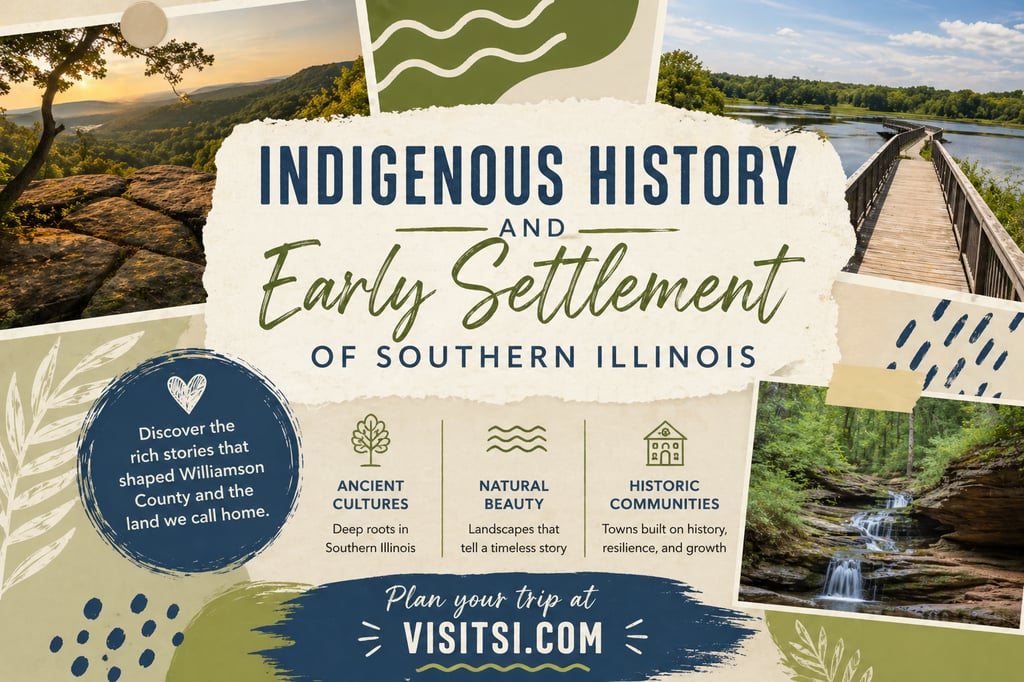
Indigenous History and Early Settlement of Southern Illinois
If you’ve ever spent time exploring Southern Illinois, especially around Marion, Carterville, and Herrin, you’ve probably felt it. There’s a quiet sense of history here that goes far beyond what you see day to day. Beneath the roads, storefronts, and trails is a story that began long before towns were established, rooted in Indigenous culture, connection to the land, and early settlement that shaped the region into what it is today.
A Land Shaped by Indigenous Communities
Long before Southern Illinois became a destination for visitors, it was home to thriving Native American communities. One of the most prominent groups connected to this region was the Illiniwek Confederation. These tribes lived throughout Illinois and developed strong, organized communities built around agriculture, trade, and a deep respect for the natural world.
The land that now makes up Williamson County was especially valuable. With fertile soil, access to water, and a mix of forests and open land, it provided everything needed for sustainable living. Indigenous communities farmed crops like corn, beans, and squash, hunted local wildlife, and created trade networks that connected them to other tribes across the Midwest.
Life here was intentional and deeply connected to the environment. The forests, rivers, and rolling hills were not just resources, they were part of everyday life and culture. That connection is something you can still feel today when you spend time outdoors in Southern Illinois.
The Landscape That Tells the Story
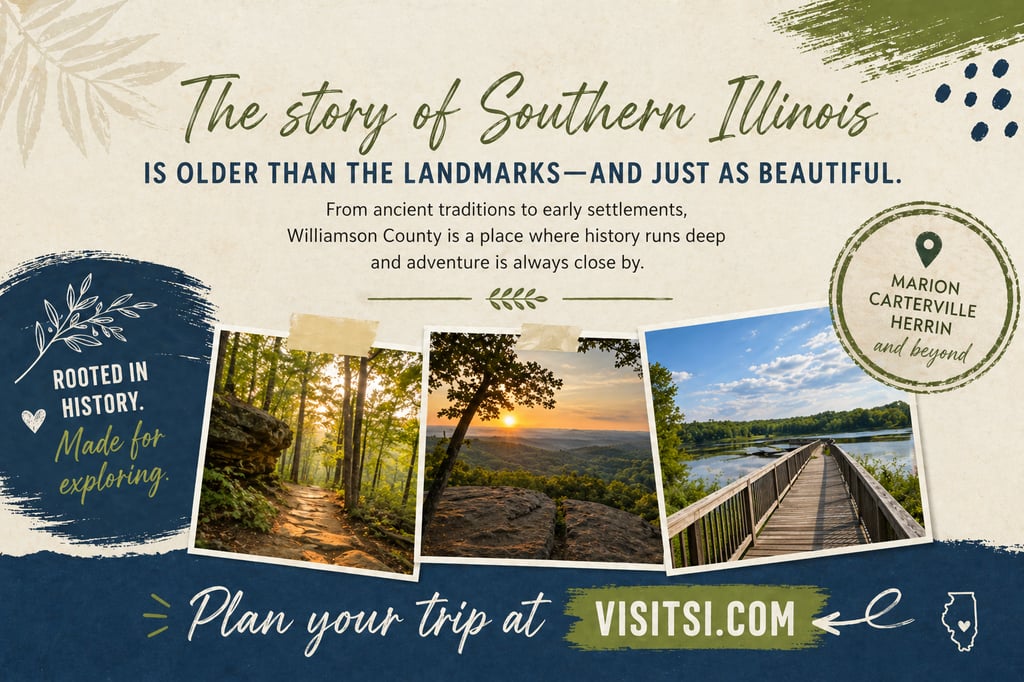
One of the best ways to understand the region’s early history is simply by exploring the land itself. Areas throughout and around Williamson County still reflect the same natural features that first drew Indigenous communities here.
The Shawnee National Forest is one of the most important natural areas in the region. With miles of trails, sandstone formations, and dense forest, it offers a glimpse into what this part of Illinois looked like long before modern development. Not far from Williamson County, it remains a place where visitors can experience the same landscapes that sustained early communities.
Closer to Marion, the Crab Orchard National Wildlife Refuge provides another connection to the past. With open water, wooded trails, and wildlife habitats, it reflects the kind of environment that supported both Indigenous life and early settlers. Areas like Devil’s Kitchen Lake add to that experience, offering scenic views and quiet spaces that feel unchanged by time.
First European Influence
In the late 1600s, French explorers began traveling through Southern Illinois. Figures like Jacques Marquette and Louis Jolliet documented their journeys through the region, encountering Indigenous communities who had already established strong and complex societies.
These early interactions led to trade but also introduced significant change. European arrival brought new goods, new beliefs, and unfortunately, diseases that deeply impacted Native populations. Over time, French settlements began to take hold in parts of Illinois, including areas not far from Williamson County.
One of the most notable early settlements was Kaskaskia, which became an important center for French culture and governance in the region. While it is not located directly in Williamson County, its influence helped shape the broader development of Southern Illinois.
Transition and Growth
Following the American Revolution, control of the Illinois region shifted to the United States. This marked the beginning of more rapid settlement and expansion.
As American settlers moved into Southern Illinois, the landscape began to change. Land was divided into farms, towns began to form, and new industries started to develop. Williamson County eventually became known for its agricultural roots and later for coal mining, which played a major role in shaping local communities like Herrin and Carterville.
For Indigenous communities, this period brought displacement and significant challenges. Treaties and policies forced many tribes to leave their ancestral lands, marking a difficult but important chapter in the region’s history.
The Foundation of Today’s Communities
Marion, Carterville, and Herrin each have their own unique stories, but all are built on land that has been shaped by centuries of human history. What feels like a small-town atmosphere today is layered with generations of culture, resilience, and change.
The same natural features that made this area ideal for Indigenous communities later supported farming, transportation, and economic growth. Railroads, local businesses, and community spaces all developed from a landscape that had long been understood and valued.
Why It Still Matters Today
History in Southern Illinois is not something you have to search hard to find. It is part of the experience. Whether you are hiking a trail, visiting a local attraction, or simply driving through the countryside, you are moving through a place with a deep and meaningful past.
Understanding the Indigenous roots of the region adds a new perspective to any visit. It allows you to see Southern Illinois not just as a destination, but as a place with a story that continues to shape its identity.
Experience It for Yourself
If you are visiting Williamson County, there are simple ways to connect with this history while enjoying everything the area has to offer.
Spend time exploring the trails and scenic overlooks in Shawnee National Forest. Walk or drive through Crab Orchard National Wildlife Refuge and take in the natural beauty. Visit local historical markers and museums to learn more about how the region developed over time.
These experiences help bring the story of Southern Illinois to life in a way that feels real and personal.
Southern Illinois is more than just a place to visit. It is a region shaped by generations of people, cultures, and traditions. From its Indigenous beginnings to its early settlements and growing communities, every part of it has a story worth discovering.
Plan your trip at VisitSI.com ✨